
Written by Renato L. Garzillo, P.Eng.
Published on Garzillo.net • Technology • Aerospace •Inovation •Space Exploration •Engineering
The launch of Artemis II is not just another headline from the space sector. It is a technical, political, and industrial milestone that deserves attention even from those who do not closely follow NASA’s missions. After decades in which crewed exploration beyond low Earth orbit lived mostly in the memory of the Apollo program, sending astronauts back toward the Moon brings an important question back into focus: why does returning to our natural satellite still matter?
These missions matter because they are never just about “going to space.” They serve as a showcase for what we are capable of building when we are forced to operate at the limits of engineering, reliability, and systems integration. By taking human beings around the Moon, Artemis II restores space exploration to one of its highest purposes: pushing technology beyond its comfort zone.
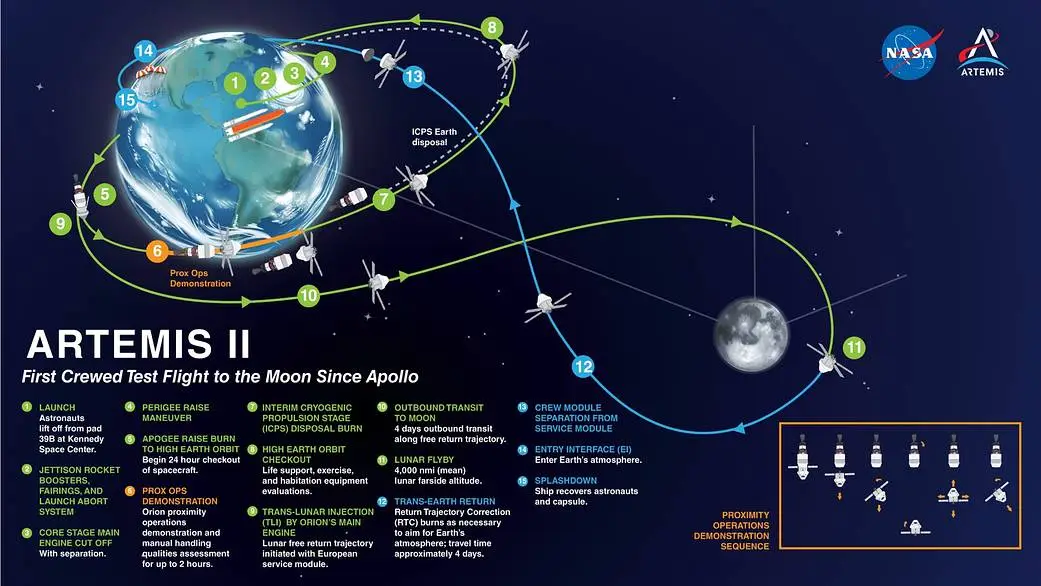
The event itself is historic. Artemis II, launched on April 1, 2026, is the first crewed mission of the Artemis program and the first human flight of the Orion capsule aboard the Space Launch System (SLS). The mission carried four astronauts on a round-trip trajectory around the Moon in a flight lasting roughly ten days. The fact that there was no lunar landing does not diminish its importance. On the contrary, this is exactly the kind of intermediate step without which the next phases would amount to little more than publicity rather than serious engineering—something not seen since the Apollo era in the 1960s.
Since childhood, I have always been fascinated by space programs. Even back then, I instinctively felt some resistance to the criticism often directed at these efforts—no matter who voiced it—on the grounds that there were more urgent problems on Earth than investing resources in space exploration. Many people still treat such programs as an expensive extravagance, as though they were a technological luxury reserved for times of abundance. That view has always struck me as superficial, and today, as an established professional, I feel that impression even more strongly. Space is one of the rare environments in which failure is not merely undesirable but often catastrophic. That reality forces designers, manufacturers, and operators to raise their standards dramatically. When a mission has to function hundreds of thousands of kilometers from Earth, with a human crew on board, there is no room for improvisation, slogans, “good enough,” or, worse, the illusion of getting “more for less.” There is only real engineering.
From a technical standpoint, Artemis II is highly significant because it tests a complete architecture for a crewed deep-space mission. We are talking about the integration of the launch vehicle, spacecraft, service module, navigation systems, life support, thermal management, power distribution, communications, and atmospheric reentry. Each of these elements is already complex on its own. Integrating them safely in a real mission with astronauts on board is a challenge on an entirely different level.
The Orion capsule, for example, is not merely a vehicle. It is a survival system and an autonomous operating platform for a hostile environment. It must keep the crew alive, functional, and safe while simultaneously managing power, data, temperature, orientation, and communications. The SLS, in turn, is the vehicle that makes it possible to place that mass on a translunar trajectory. And the European service module, provided by ESA, highlights something increasingly clear: modern space technology is no longer a purely national undertaking. It depends heavily on international networks of highly specialized expertise.
That point deserves emphasis. When we watch a mission like Artemis II, we are not simply watching a rocket lift off. We are witnessing the result of years of cooperation among agencies, suppliers, laboratories, component manufacturers, software teams, and specialists in materials, telecommunications, and control systems. It is a practical demonstration that advanced technology does not emerge from improvisation or wishful thinking. It comes from method, sustained investment, validation, and technical discipline.
But perhaps the most important point is this: the value of missions like Artemis II extends far beyond the space sector. Often driven at first by public investment, this kind of progress eventually reaches the private sector and generates value for society as a whole.
Whenever a program of this scale moves forward, it pushes innovation in materials, electronics, power systems, embedded software, sensors, telemetry, thermal management, reliability, environmental testing, and precision manufacturing. This is not romanticism; it is industrial reality. To survive in deep space, systems must be lighter, stronger, more efficient, and more fault-tolerant. Those demands end up raising the standard of technological development in many other sectors here on Earth.
In that sense, the aerospace industry often functions as an extreme laboratory—one in which the limits of risk and performance are tested under conditions that would be considered too severe for many other industries. Solutions developed for critical missions can influence fields such as aviation, defense, energy, telecommunications, transportation, and industrial automation. Not every space technology becomes a consumer product, of course. But it almost always helps build expertise, methodologies, and industrial ecosystems that later spread into other applications.
There is also a human dimension that is central to all of this. A crewed mission does not test only engines, computers, and structures. It tests human-machine interfaces, operational logic, cognitive load, contingency procedures, and the ability to make decisions under constraint. In other words, it tests whether the technology was truly designed to serve the human operator in a critical environment. That has enormous value for any sector that works with complex systems, whether in biomedical solutions, control systems for a nuclear power plant, or even high-performance decision-making and logistics systems used by major delivery companies.
Artemis II also symbolizes something that should not be underestimated. Civilizations need projects that challenge their own capacity to execute. Without them, technology risks becoming trapped in short market cycles, incremental gadgets, and solutions designed only for immediate consumption—things that gradually lose their added value. Lunar missions restore a strategic dimension to technological development. They force societies to think in decades, not just in the next quarter.
Of course, costs, priorities, and political choices can all be debated, and that debate is entirely legitimate. But one thing is difficult to deny: when a mission like Artemis II takes place, it reactivates a kind of technological ambition that rarely emerges from small projects or from periods marked by a lack of historical vision. And without large-scale technological ambition, progress tends to become fragmented or pushed into the background.
Behind what many people dismiss as futile—sending human beings to a distant, uninhabited place simply to prove that it can be done—Artemis II matters for more than just returning humans to the vicinity of the Moon. It matters because it demonstrates, under real conditions, what serious engineering, international cooperation, and long-term vision are still capable of achieving. More than a journey, it is a rehearsal for the next phase of human presence in space. And, as so often happens in moments like this, the benefits do not remain confined to the rocket, the spacecraft, or the space agency. They gradually spread across the entire technological chain and, ultimately, throughout society. In this case, the Moon is both destination and pretext. The real movement lies elsewhere: in forcing human technology to rise to a higher level.
Written by Renato L. Garzillo — electronics engineer, writer, and entrepreneur. As a child, he dreamed of becoming an astronaut; as an adult, he remains deeply engaged with the technological meaning of space exploration.